


If there is any continent that has been blessed abundantly with resources, it is Africa. The land is endowed with countless forms of wealth. Yet, as Dr. Kwame Nkrumah warned, “her earth is rich, yet the products that come from above and below her soil continue to enrich, not Africans predominantly, but groups and individuals who operate to Africa’s impoverishment.” Decades later, his words remain painfully true.
The trade decisions African nations make and the collaborations they enter continue to work against the continent’s progress. One may ask: How can a continent so rich in natural resources still rank so high in poverty, unemployment, mass migration, hunger, and instability?
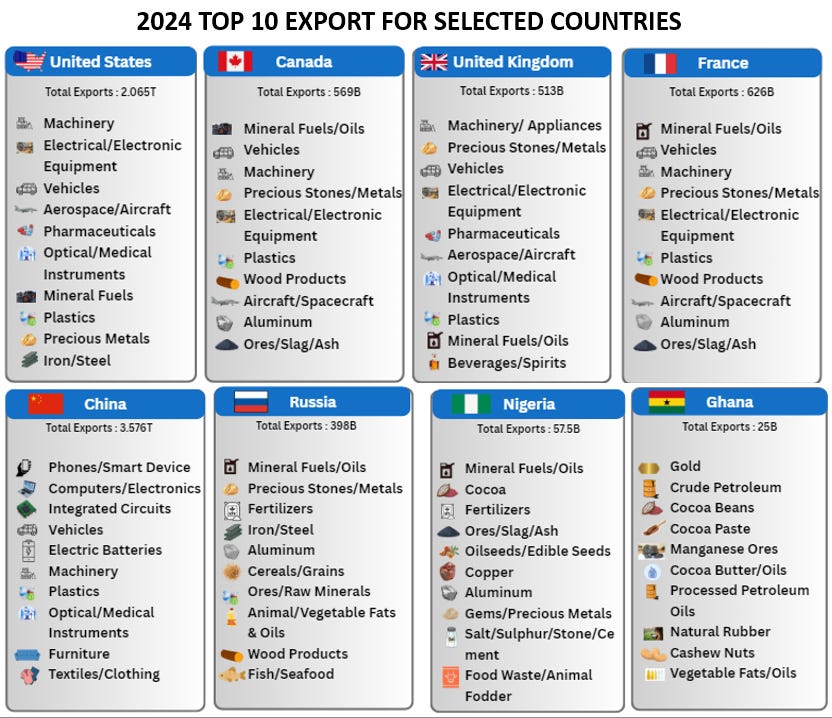
Carefully examine the top 10 export products of selected nations above: the United States and Canada from the Americas; England and France from Europe; China and Russia from Asia; and Ghana, Nigeria, and the Democratic Republic of Congo from Africa. The results reveal patterns that are impossible to ignore.
Industrialized economies like the United States, Canada, France, China, and Russia export a wide range of manufactured and value-added goods—machinery, vehicles, electronics, chemicals, aerospace equipment, pharmaceuticals, and more. Their wealth is built on industries, factories, research, and technology.
In contrast, resource-rich developing economies such as Ghana, Nigeria, and the DRC rely heavily on a narrow set of raw materials and commodities—gold, oil, cocoa, cobalt, timber, or one or two other raw materials. Their export baskets lack diversification making them more vulnerable to fluctuations in global commodity prices and are dependent on raw materials, even though they produce some of the highest-quality natural resources in the world.
Put simply, Africans are the only economies that enjoy the release and export of her precious raw materials to other nations.
Despite having some of the highest-quality minerals and natural resources in the world, African export totals remain only a fraction of what a single industrialized country exports. I cannot point to a single major finished product that a country like Ghana has developed into a globally exported good.
Pattern of Resource Management in Ghana
I have discovered a pattern Ghana leaders follow regarding how resources of the nation are handled.
Ghana’s raw materials are sold cheaply to foreign nations or exchanged for royalties through partnership agreements with foreign corporations.
These nations establish factories in their own countries, hire thousands of their people, and create generational wealth through processing and manufacturing.
They add value to the cheap resources obtained from Ghana .
They sell the finished products—phones, jewelry, machines, batteries—back to Ghanaians at exaggerated prices.
In the end, foreign countries that do not own the resources earn more from them than Ghanaians do.
Most painful of all is that even within Africa—Ghana included—the mining of our own resources is not done by Africans. Almost every major mining field is leased to foreign companies that control the operations while African governments receive what they call a “royalty,” usually between 5% and 10%.
Since the discovery of gold in Obuasi and diamonds in the Western and Eastern Regions, European and Asian corporations have held long-term concessions allowing them to mine for decades. In return, Ghana receives a small royalty and is left with the environmental destruction—mosquito-breeding pits, ruined lands, and displaced communities.
Meanwhile, these companies ship the gold and other minerals abroad as raw materials for their own industries, creating jobs for their people, building value for their nations, and eventually selling finished products back to Ghanaians at higher prices.
The story is the same with oil discovered in Cape Three Points. Ghana granted rights to foreign companies for only a 9% royalty, while local communities suffered the loss of fishing grounds, broken employment promises, forced relocations, and long-term destruction of livelihoods.
Cocoa tells the same heartbreaking truth. Ghana has been a leading cocoa exporter since early 1900s, yet cocoa farmers remain among the poorest citizens. Our leaders continue to export raw beans instead of processing them into finished products that could create thousands of jobs and multiply national wealth.
And these examples go on endlessly. For almost every valuable resource we discover, the first instinct of our leaders is to lease it to foreign nations for royalties. No one thinks of maximizing it ourselves—building capacity, adding value, creating industries, and securing long-term prosperity for today’s generation and the ones yet to come. We keep handing away what could become multi-generational wealth.
Why This Pattern of Resource Management
It reflects how shallow and short-term our leadership has become. Many leaders refuse to plan long-term; they prefer quick money. The concessions look big at first glance, but in reality, they are crumbs compared to the true value of the resources handed away. Instead of thinking about the future and developing the capacity to manage these resources ourselves, they settle for instant gratification.
People often excuse this behavior with claims like “lack of capital” or “high cost of investment.” But they forget that Rome was not built in a day. Progress requires discipline and delayed gratification. Quick money brings quick suffering; long-term thinking builds long-term strength.
Another root of this problem is the division caused by partisan politics. From childhood, Ghanaians are conditioned to believe that our current political system is the only viable one. Yet this system encourages short-term decisions. Parties invest heavily to win power, and once in office they have only four years to recover their investment before elections return. So they rush deals that benefit their political group, not the nation.
If oil or minerals are discovered during their administration, they quickly sign deals so their party can benefit before their term ends. Long-term national planning becomes impossible. Leaders avoid initiating long-term projects because they fear a future government will claim the credit. So they choose short-term gains that benefit themselves before they exit office. This mentality is destroying our nation.
iPhones Production - A lesson Ghana leaders can learn from China
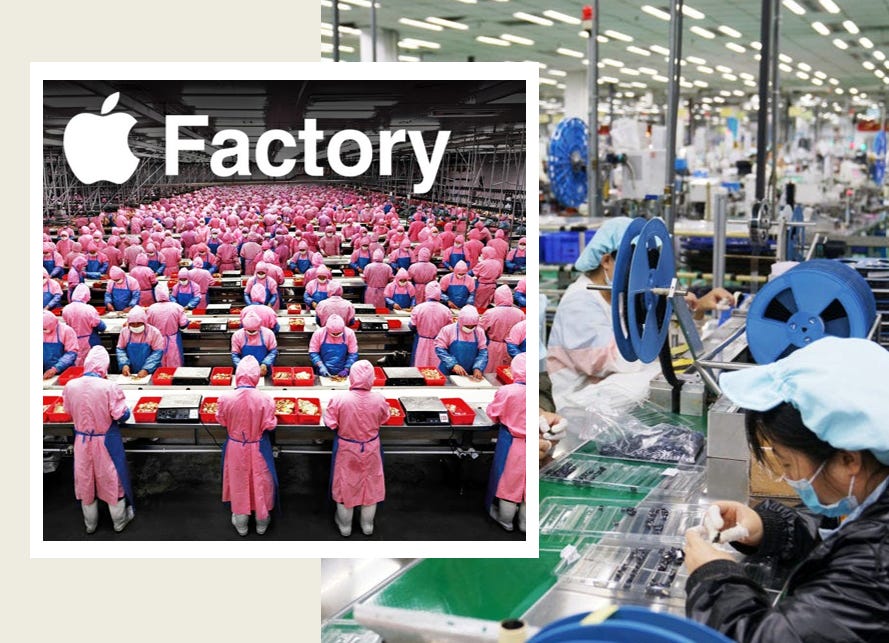
When we talk about iPhones, most people forget a simple truth: although Apple is an American company, the heart of the iPhone beats in China. China sits on some of the world’s most important rare earth minerals—just like many African nations—but unlike Ghana, China refused to play the role of a raw-material exporter begging for 5% - 10% royalties. They did something radically different.
They told Apple and every other Western corporation: “If you want our minerals, if you want our labor, if you want our market… then you must build your factories here.” Not in California. Not in Europe. In China. That one decision reshaped the destiny of over a billion people. It meant jobs stayed in China. Value stayed in China. Technology stayed in China. And expertise were built over time and stayed in China. Over time, this strategy produced world-class companies like Huawei, Xiaomi, Lenovo, and BYD — giants that now challenge the very nations that once looked down on China.
And let’s be clear: this transformation didn’t happen in one president’s term or through quick deals designed to make a few elites rich overnight. It took 10–20 years of disciplined, visionary leadership — leaders who understood that real development comes from controlling your resources, refining them at home, and forcing foreign corporations to respect your terms, not the other way around.
Today, Apple’s largest manufacturing centers are on Chinese soil, creating more than 10,000 direct jobs and over 5 million indirect jobs, fueling entire cities, funding local innovation, supporting local economy through taxes to Chinese governments and creating an huge job market where ordinary citizens do not need to flee abroad to survive. They created opportunity at home because they kept ownership at home.
Now Ghana stands at that same crossroads with lithium — a resource even more powerful than oil in the coming decades. Parliament will soon gather, and Ghana will be watching. Will our leaders follow the path of China and secure a future where Ghanaian engineers, miners, technicians, and innovators build industries on our own land? Or will they repeat the painful old pattern — accepting quick royalties, allowing foreign corporations to take our raw minerals, and leaving our youth with nothing but unemployment and dreams of traveling abroad for survival? This decision is not just about lithium. Ghana finally takes control of its destiny remains a question for the gods.
Lithium Royalty Saga
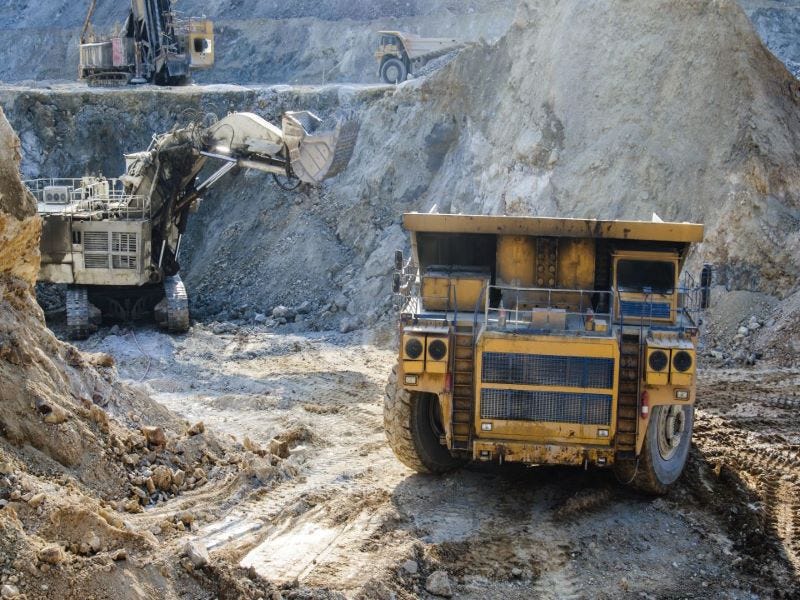
Consider the recent lithium royalty deal by the current government of Ghana. The royalty was initially set at only 10%. Lithium is one of the most critical minerals in modern technology.
Foreign companies want Ghana’s lithium because it powers the modern world—electric vehicle batteries, large-scale solar and wind energy storage, and everyday electronics like phones and laptops. Lithium is also essential in aerospace, defense, robotics, and future electric machinery, making it the “new oil” of the global economy. Whoever controls lithium controls the EV industry, renewable energy, future transportation, high-tech manufacturing, and the global battery supply chain. That is why foreign corporations pursue lithium with such aggression.
Do our leaders know this? Do they understand that Ghana’s lithium could become a global industry built on our own soil, creating jobs and wealth for generations? If they do, why are they so quick to exchange that potential for a 5%–10% royalty?
This is one moment where our leaders should stand together to protect Ghana’s future. They should have said, “We must think of the future of our children.” Instead of leasing it away, they can acquire the machines, trained the youth, and built a national lithium-processing industry owned and run by Ghanaians.
Even if it took ten years to build, would that not be better than giving away 90–95% of the wealth for quick cash? For over 50 years, we have repeated the same mistakes with gold, cocoa, oil, bauxite, manganese, and more. Meanwhile, the youth are forced to travel abroad in search of jobs that could easily be created here if we processed our own resources.
Kwame Nkrumah warned long ago: “So long as foreign interests control industry and finance, the wealth created by African labor and resources will go to enrich others.” He emphasized that true freedom requires economic independence, which can only come from developing our own industries, commerce, and banking. He said it plainly: “If you do not build factories, you will forever be selling cheap and buying expensive.”
Our leaders also fail to recognize that what appears as “help” from foreign nations often comes at the cost of surrendering our wealth. There is no such thing as a free lunch. Foreign countries do not cross oceans to help Africans; they come to pursue their interests. They exploit our resources with the cooperation of local leaders who prioritize personal gain over national interest and development.
Let this lithium opportunity become the turning point. Let it be the moment where we regain confidence in ourselves, believe in our own ability, and commit to building something that will last beyond our lifetime, for posterity will judge every action we take today. Let us stop being exporters of raw materials — a habit born of laziness and short sight — and become builders, innovators, and long-term thinkers. Let us set a new standard for how we handle our resources. Even if we fail, we know we tried doing something with good intentions of the nation and future generation at heart. We shall learn from our mistakes and bounce back stronger. It is time for the youth to speak up and stand up for change.