


Ghanaian Cultural Values
Every society did not begin today. Like the saying goes, Rome was not built in a day, and neither was Ghana.
Ghana is a country whose identity has been shaped through centuries of history, culture, traditions, and shared values. Our growth as a people has not only been built on our existence as tribes and ethnic groups, but most importantly on the moral and cultural foundations inherited from our ancestors.
Despite our diversity in tribes, languages, customs, and traditions, there are certain values that unite us as a people—especially values concerning family, morality, respect, and social order.
Whether people admit it or not, long before foreign religions and cultures arrived on African soil, our ancestors already had strong spiritual systems and moral structures that guided society.
Our cultural heritage clearly shows that African societies valued the sanctity of marriage between a man and a woman. I do not know of any traditional Ghanaian society or historical African civilization that promoted prostitution, adultery, fornication, or same-sex relationships as acceptable moral standards.
Traditionally, marriage was understood first as a union between families and secondly between a man and a woman. That has always been the foundation of our societies. Anything outside of that was generally considered morally unacceptable.
This is why many Ghanaians strongly reject the modern LGBTQ ideology being promoted globally today. Across generations, the idea that people of the same sex should engage in intimate relationships has largely been viewed as foreign to our historical values and cultural identity.
Our chiefs know this.
Our elders know this.
Our religious leaders know this.
Our politicians know this.
Even people who may not be morally upright themselves acknowledge this reality.
Foreign Invasion of Our Culture
Yet despite this, modern westernization has deeply influenced our society, creating confusion and division among us.
Through foreign education systems, media, politics, religion, entertainment, and globalization, many Ghanaians have gradually begun adopting ideas simply because they originate from the Western world.
One thing I have observed about Ghana is this: many of us associate westernization with civilization and modernization. Because of that mentality, many young Ghanaians now imitate almost everything they see in the West without first asking whether it aligns with our values, identity, or long-term future.
Unfortunately, our educational systems often reinforce this mentality. Young people are increasingly taught to admire and imitate foreign lifestyles while gradually disconnecting from their own cultural foundations. In the process, many become emotionally and ideologically attached to things that were historically alien to our societies.
There are now international organizations operating under the banner of “human rights” that actively promote these ideas across Africa. Some provide funding, jobs, scholarships, and financial opportunities tied to these causes. As a result, some Africans begin supporting these movements—not necessarily because they genuinely believe in them culturally, but because there are financial benefits attached to them.
There are people in Ghana who openly defend and promote these ideologies largely because they create opportunities, connections, funding, and access to wealth. Some do not even stop to think about the long-term cultural consequences on future generations.
Religion has also played a complicated role in this issue. Ironically, many of the same foreign religious systems that transformed African societies are now themselves changing in the West. Today, some Western religious institutions openly support same-sex marriages and LGBTQ practices. And because African branches of those institutions often follow the authority and direction of their foreign headquarters, those influences gradually spread into African societies as well.
But perhaps the greatest influence of all is politics.
Many Ghanaian leaders personally know that these ideas are unpopular among the majority of the Ghanaian people. They know the cultural position of the country. Yet many remain silent or hesitant because of international political pressure from foreign governments, international financial institutions, global organizations, and powerful Western allies.
The truth is simple:
Money controls politics.
Foreign aid, loans, trade relationships, and diplomatic pressure have become tools used to influence weaker nations. Because many African economies are heavily dependent on foreign support, political leaders often fear opposing Western interests openly.
This brings us to the issue of political willpower.
Do Ghanaian leaders truly have the power to resist?
That is an important question.
Consider the current LGBTQ bill debate in Ghana. If a Ghanaian president signs a strong anti-LGBTQ bill into law, there are potentially serious international consequences.
There have been warnings about possible financial repercussions, including threats to international funding, foreign investment concerns, tensions with Western allies, and possible complications involving institutions such as the IMF and the World Bank.
There are also fears that Ghana’s trade relationships and international economic support could be affected.
Whether one agrees with these pressures or not, they reveal an uncomfortable truth:
Ghana still operates under systems where major external powers heavily influence domestic political decisions.
So ask yourself honestly:
If you were the sitting president of Ghana, would you hold firmly to your cultural convictions even if it meant risking severe economic pressure and international backlash?
Or would you compromise in order to protect the economy and maintain foreign relationships?
That is the difficult position many African leaders find themselves in today.
Political Trickery of Current LGBTQ Issues in Ghana
Our leaders know these realities very well, yet they use them to play political games with the Ghanaian people.
During President Akufo-Addo’s second term as President of Ghana, we witnessed a similar situation surrounding the anti-LGBTQ bill. Hon. Sam George became one of the leading public figures pushing aggressively for the passage of the bill through Parliament. He worked tirelessly and passionately to ensure that it was passed, and afterward openly challenged the NPP government to sign it into law.
But I dare say that he and many others involved fully understood the international consequences and pressure that could follow if the bill became law.
In my opinion, the strategy was political.
The issue became an opportunity to make the sitting NPP government appear weak, cowardly, and disconnected from the cultural values of ordinary Ghanaians. The pressure was designed to corner the government politically and make Ghanaians angry with the NPP ahead of elections so that the NDC could capitalize on public frustration and regain power.
Now the NDC is in power, and what do we see?
The same bill that was already drafted and passed under the previous administration has suddenly become a matter of “procedure” and “process.”
We are now being told that because of the newly constituted Parliament, everything must begin again from scratch. Fair enough—Ghanaians waited patiently.
Recently, the bill was reportedly passed again in Parliament, and immediately the pressure shifted to President Mahama to do exactly what the NDC accused President Akufo-Addo of failing to do: sign the bill into law.
But what happened next?
 Tiktok failed to load.
Enable 3rd party cookies or use another browser
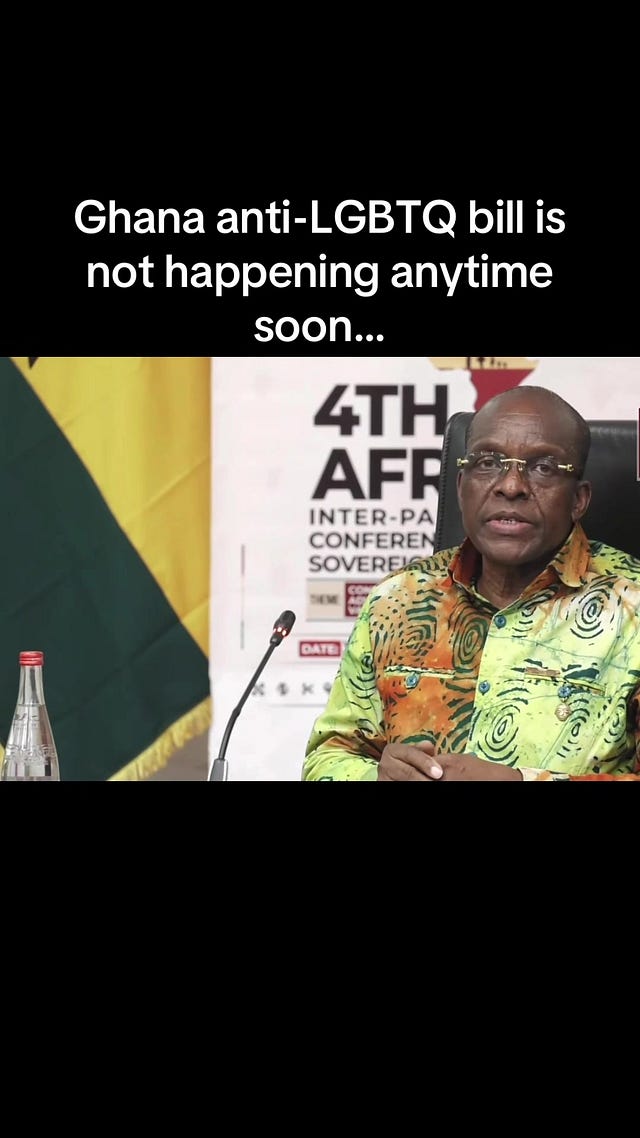
The Speaker of Parliament, Alban Bagbin, came out claiming that the process through which the bill was passed was not properly done and that everything must start all over again with wider consultations and proper parliamentary procedures.
In fact, he even appeared surprised that the bill had been passed.
To me, that level of political theater is difficult to take seriously.
How can the Speaker of Parliament claim surprise over what is arguably one of the most controversial and nationally discussed bills in recent Ghanaian history—a bill allegedly passed under the supervision of Parliament itself and under the watch of his own deputy?
That raises serious questions about hypocrisy, competence, and the level of respect our political leaders truly have for the intelligence of the Ghanaian people.
I dare say that with the new procedural delays introduced, it may take another one or two years before any meaningful anti-LGBTQ legislation is finalized again.
And honestly, I strongly suspect this is a coordinated political strategy involving elements within the presidency, the ruling NDC, and parliamentary leadership to delay the matter while protecting President Mahama from becoming the direct face of either signing or rejecting the bill.
The political calculation is obvious.
They need to distance him from blame.
They understand the same fears the NPP government faced—fear of international backlash, economic pressure, diplomatic consequences, and possible financial sanctions from Western powers and international institutions.
So rather than openly refusing the bill, the strategy appears to be endless delay, procedural confusion, and political maneuvering.
My personal belief is that even if President Mahama eventually signs such a bill, it would likely happen toward the very end of his presidency when he has little left to politically lose.
At that point, major loans, foreign agreements, diplomatic arrangements, and financial negotiations with Western institutions may already have been secured. Then he could sign the bill late in office, gain popularity among sections of the Ghanaian population, and leave the next administration to deal with whatever international consequences may follow.
And if no major consequences come, he would still receive political credit for “defending Ghanaian values.”
That is how political games are played.
This should teach Ghanaians an important lesson:
many politicians care first about political survival, power, image, and legacy before they care about principles, values, culture, or the long-term future of the people.
Both major political parties often accuse each other publicly while privately fearing the exact same international pressures.
And in the middle of all this political maneuvering sits the ordinary Ghanaian citizen, emotionally invested in cultural issues while political elites calculate strategy behind closed doors.
The Danger for Future Generations
The greatest danger in all of this is what it means for future generations.
Every societal problem begins somewhere. When problems are ignored at the early stages instead of being addressed directly, they often grow into something much larger, chronic, and harder to control later.
That is exactly what many people believe is happening in Ghana today.
We are now seeing increasing numbers of young people openly identifying with LGBTQ lifestyles, and at the same time resistance against anti-LGBTQ laws continues to grow stronger both locally and internationally.
Whether one agrees or disagrees with the movement, the reality is that the issue is becoming more deeply rooted within younger generations.
Many people point to countries in the Arab world as examples of societies that firmly maintain their cultural and religious identity despite international pressure.
Those societies openly defend their traditions, religion, and family structures without apology.
For example, during the 2022 FIFA World Cup in Qatar, Western activists and media organizations criticized the host nations over issues relating to alcohol restrictions, LGBTQ matters, and cultural laws. Yet those governments made it clear that visitors were expected to respect the culture and values of their nation. They stood firmly behind their identity.
And that, many Africans argue, reflects leadership rooted in cultural confidence rather than fear of foreign pressure.
The concern many Ghanaians now have is that if the country continues avoiding difficult conversations about identity, culture, sovereignty, and values, future generations may inherit a society that no longer understands what it stands for.
Whether people agree or disagree with these arguments, one thing remains certain:
A nation that loses confidence in its own cultural identity eventually becomes vulnerable to external influence in every area of life.
Our country’s leadership lack nationalist(leaders who will put national interest and values first). It is long time that the youth stand up and demand accountability from Ghanaian leaders before future generations inherit a nation disconnected from its own identity.