


J.A. Kufuor, Ghana’s former president, once remarked that “corruption is as old as Adam.” To a large extent, I agree with this statement—not in the sense of justifying or excusing corruption, but in acknowledging a deeper truth: there is truly nothing new under the sun. Long before our time, great civilizations and powerful governments rose and fell. Just as in our era, those societies grappled with leadership failures, corruption, mismanagement, and the misuse of state resources for personal gain.
One of the greatest civilizations to ever exist was the Roman Empire. For centuries, Rome governed vast territories through a complex and sophisticated political system. It operated a mixed structure that combined elected officials such as consuls, powerful popular assemblies like the Centuriate and Tribal Assemblies, and the highly influential Senate. In many ways, this balance between democratic participation and aristocratic authority resembles political systems found in many modern states today. Yet despite this sophistication, Rome was deeply flawed. Corruption, abuse of power, mismanagement, and state misappropriation were widespread and persistent.
Despite leadership corruption in such a brutal and ruthless era, what is particularly striking is that Roman leaders developed a deliberate governing playbook—a calculated strategy designed to control, distract, and pacify the population, particularly during periods of corruption, economic hardship, or political instability. These tactics were often subtle and difficult for ordinary citizens to recognize. Over time, people became accustomed to their conditions and stopped questioning the system until hardship became unbearable and unrest finally erupted.
In modern-day Ghana, evidence of corruption, mismanagement, and the misappropriation of public funds dominates news headlines almost daily. The consequences have been severe, creating immense hardship and instability for ordinary citizens. Yet despite this reality, a significant portion of the population—especially the youth—appears largely disengaged. Even when people recognize that something is wrong, they often fail to give these issues the sustained attention and urgency required to confront them meaningfully.
To understand this phenomenon, it is useful to revisit an ancient strategy of governance that continues to be applied in modern politics, including in Ghana: distraction through entertainment.
The Playbook of Distraction Through Entertainment
In the ancient world, entertainment was not simply a source of leisure; it was a calculated instrument of governance. Rulers understood that controlling attention and emotion could be just as effective as controlling laws or armies. As a result, large public spectacles were deliberately sponsored to manage public sentiment, suppress dissent, and maintain stability during periods of corruption, economic hardship, and political uncertainty. This strategy worked not because people were uninformed, but because it aligned closely with predictable patterns of human behavior.
The Roman Empire provides the clearest example through what later became known as panem et circenses—“bread and circuses.” Roman emperors and political elites invested enormous resources in gladiatorial contests, chariot races, wild animal hunts, public feasts, and free grain distributions. These spectacles ensured that citizens were fed and continuously entertained, keeping their emotions engaged while their attention was drawn away from matters of governance. Entertainment did not replace political institutions, but it steadily eroded the public’s impulse to question them.
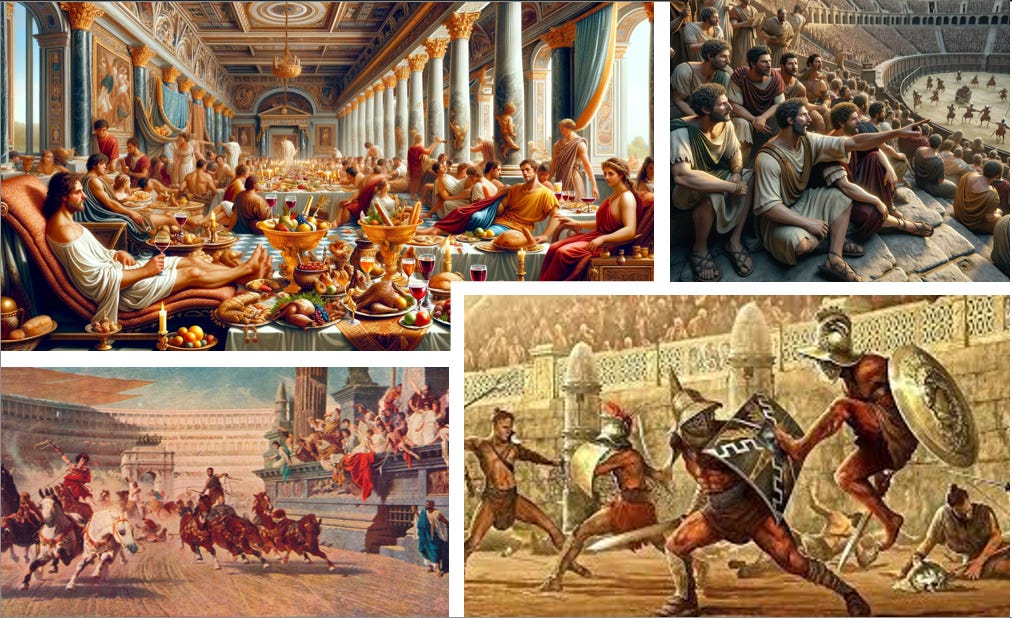
The underlying logic behind this system was simple and effective. If the population’s basic survival needs were met and their emotions constantly engaged, they would be far less likely to question the government. This strategy was cost-effective compared to addressing structural problems, and it created loyalty by portraying the emperor as generous and benevolent. By presenting the ruler as a generous provider of food and entertainment, loyalty was cultivated without meaningful reform. Public frustration that might have been directed toward high taxes, military failures, or corruption was instead released in the arena. When people were focused on games, they were far less likely to revolt or scrutinize mismanagement.
This reliance on entertainment intensified during times of crisis. Periods of food shortages, economic downturns, military defeats, or political scandal were often accompanied by an expansion of public games and spectacles. Rather than confronting the underlying causes of instability, rulers used performance to temporarily calm the population. The reign of Emperor Commodus illustrates this clearly. As criticism of his leadership and allegations of corruption mounted, he devoted increasing resources to gladiatorial shows and even entered the arena himself, transforming political dissatisfaction into spectacle and personal display.
These events were not politically neutral. They stirred powerful emotions—excitement, fear, pride, and tribal loyalty, particularly through rival chariot racing factions. Such emotional stimulation united citizens around shared spectacles instead of shared political demands. It offered psychological escape, redirected frustration, and reinforced obedience by casting the emperor as the provider of joy and relief. People left the arena exhilarated, not reflective. Corruption faded from their immediate thoughts.
At the core of all these strategies was a deep understanding of human nature. People are less politically active when they are entertained, distracted, fed, emotionally satisfied, and given the illusion of participation—through cheering, betting, or supporting teams. Conversely, people become politically dangerous when they are hungry, idle, angry, aware of corruption, and united around a shared political cause. Entertainment, therefore, became a practical and effective tool of social control.
This strategy, however, had its limits. When economic collapse became too severe, no amount of entertainment could suppress public anger. However, during periods of routine governance, distraction through spectacle remained one of the most powerful methods rulers used to maintain control.
Rome was not alone in this practice. Ancient Egypt, China, Byzantine empires, Mesoamerican civilizations, etc. organized grand religious festivals, dynasty celebrations, ritual games and public feasts that served similar purposes.
Application in Modern-Day Ghana
In modern times, particularly in Ghana, these tactics of distraction are not always obvious, but they are deeply embedded and actively reinforced. The youth of today tend to focus far more on the present than on the future. While many openly complain about corruption, mismanagement, and government misappropriation that directly affect their lives, very little is done in terms of sustained civic engagement or political participation to challenge these conditions.
One of the most visible forms of distraction is political shows. In Ghana, political campaigns have increasingly evolved into entertainment spectacles. Political leaders pay musicians and celebrities to perform at rallies, prioritizing excitement over substance. Instead of engaging citizens on governance, economic reform, and long-term national development, campaigns are held in stadiums and public spaces designed to attract large crowds, crowned with music, dancing, “jama”, and celebration, while meaningful political discourse is largely absent.
Both major political parties—the NPP and the NDC—have consistently collaborated with popular musicians to produce campaign songs in almost every election cycle. These songs are designed to emotionally mobilize voters rather than educate them on policy or vision. For the NPP, songs such as Daddy Lumba’s Nana Winner and 4 More for Nana are well known. For the NDC, tracks like Nacee’s Kwen Kwen and Onaapo serve a similar function. This pattern reveals how vulnerable and easily distracted the youth have become in the political process.
Beyond election campaigns, political leaders also sponsor or actively participate in community entertainment events under the guise of social engagement. I am not opposed to entertainment itself. However, it becomes deeply concerning when high-profile leaders—ministers, parliamentarians, and senior officials—who should be focused on economic stability, job creation, investor confidence, and international relations, instead devote significant time and public resources to organizing low-level entertainment. Rather than prioritizing sustainable industries and long-term solutions to youth unemployment, they offer one-time spectacles that mirror the same ancient tactics used to pacify the masses.
A recent example is the Ashanti Regional Minister’s involvement in organizing and launching Kumasi Fest, where celebrities were invited to entertain the public for a day or two. While some may argue that such events bring money into the region, this economic benefit is temporary. Once the excitement fades, the youth are left with the same unemployment, frustration, and disappointment. Other examples include Detty December events, Tidal Rave Festival, Afrochella, Rapperholic, Bhim Festival, Likor on the Beach, Shay Concert, etc.
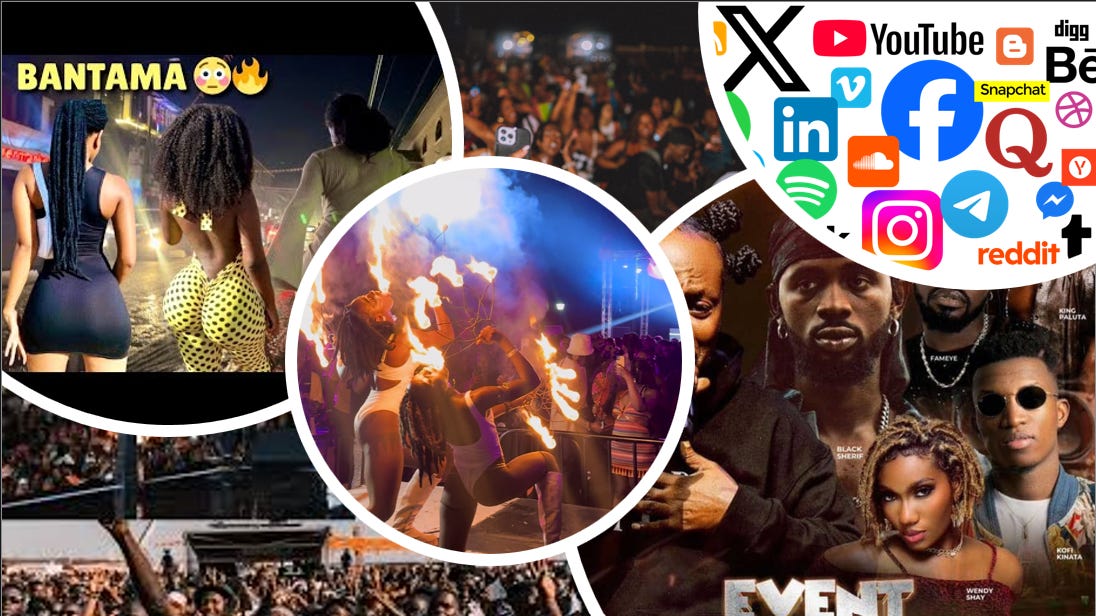
What is even more troubling is what often occurs at these events. Several viral videos have shown young adults engaging in sexual activities in public during concerts, including events associated with Wendy Shay. What is captured on camera likely represents only a small fraction of what occurs within the crowd. Yet political and traditional leaders rarely intervene or introduce policies to regulate such behavior. They tolerate it because it keeps the youth entertained and distracted from engaging deeply with political and national issues.
Sports provide another powerful distraction. Ghanaian youth—particularly young men—are deeply consumed by Western sports. Many spend entire weekends watching the English Premier League, La Liga, Serie A, and other leagues from morning until late at night, followed by weekday fixtures in the Champions League and Europa League. Beyond lost time, many also spend money they do not have on betting and gambling, worsening their financial struggles.
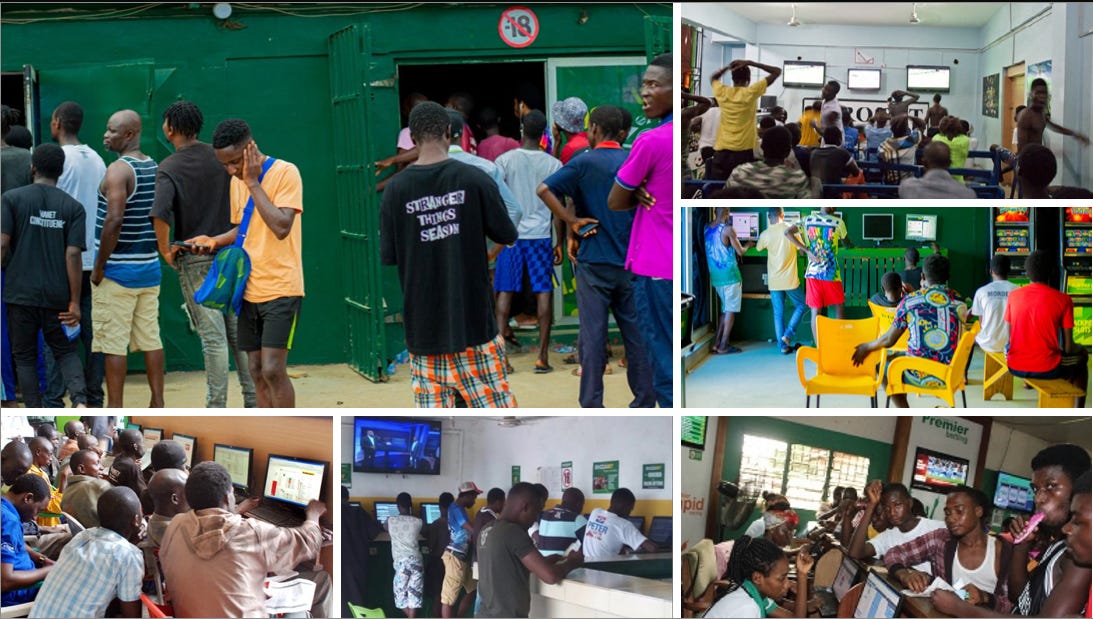
This cycle of sports entertainment offers temporary pleasure while diverting attention from pressing socio-economic issues. It is therefore unsurprising that many celebrate leaders who advocate for reduced DStv prices. The youth often respond more positively to comfort and entertainment than to accountability and reform. It is also unsurprising that millions of dollars are spent on global sporting events such as the upcoming 2026 World Cup while many citizens lack basic necessities. As history has shown, public realization often comes only after the celebrations end, when scandals involving inflated costs and financial mismanagement surface at the Public Account Committee meetings .
Social media further intensifies this distraction. Most youth today spend more time on social media than on any productive activity. Hours are consumed watching short videos, reels, and comedy skits that add little to personal development. Significant amounts of money are spent on internet data rather than on learning skills in finance, politics, entrepreneurship, or technology from these platforms.
It is especially disheartening that when individuals like Mr. Obeng Darko organize free training programs across university campuses—focused on financial literacy, entrepreneurship, and self-reliance—attendance is often low, despite the proven impact of these initiatives transforming lives by reshaping mindsets and empowering young people to build something meaningful.

Ironically, the moment a concert featuring popular celebrities is announced—whether free or paid— venues become overcrowded. Even more troubling is leaders’ lack of support and interest in movements that genuinely seek to empower the youth intellectually and economically. Instead, overwhelming support is given to entertainment that keeps the youth distracted from pursuing long-term goals and engaging with issues that truly matter. This pattern is not accidental; it is sustained because a distracted youth is easier to control than an informed and organized one.
Ask yourself, why on earth have our Ghanaian political and traditional leaders created an environment or society where sex and entertainment thrive as opposed to creating a society where business, industry, and innovation thrive?
Modern societies may no longer rely on gladiators or imperial arenas, but the underlying principle remains unchanged. Today, excessive focus on sports, nonstop media cycles, celebrity culture, and political theater serves the same function these spectacles once did. They consume attention, shape emotions, and divert focus away from corruption, accountability, and deep structural failures.
Those who claim to have genuine intentions of leading Ghana into a better future must therefore take responsibility for reshaping the mindset of the people, particularly the youth. Without a deliberate shift away from constant distraction toward critical thinking, civic engagement, and national development, meaningful progress will remain elusive. When citizens are distracted, leaders are rarely challenged. When leaders are not held accountable, development becomes an illusion. The time to demand reform is now.