


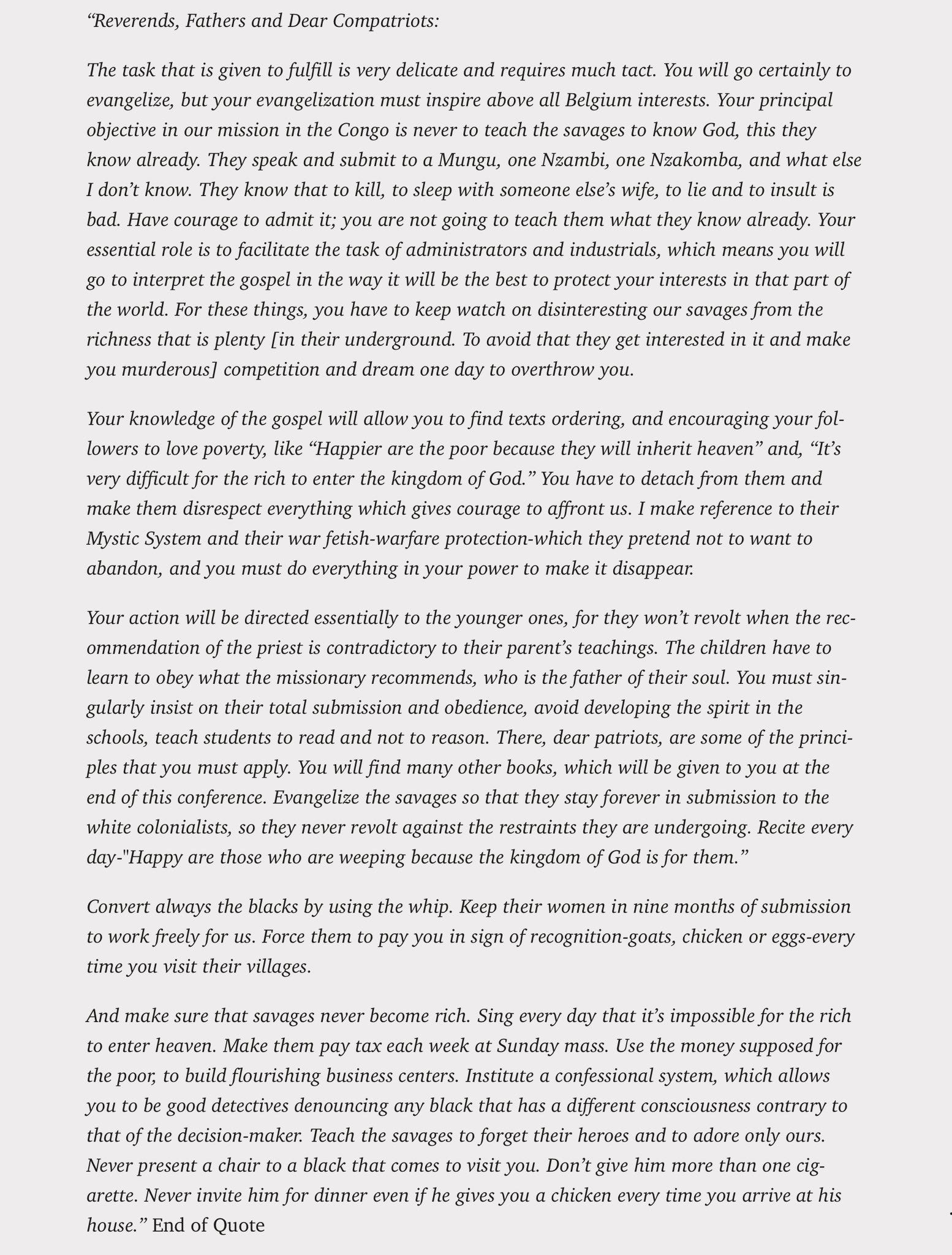
In 1935, Mr. Moukouani Muikwani Bukoko, while working for missionaries in the Congo, reportedly bought a second-hand Bible from a Belgian priest. Inside, he found a letter dated 1883, attributed to King Leopold II and addressed to colonial missionaries heading to Africa. The contents of that letter are shocking and devastating.
Read the letter below.
In order to understand your present, you must first go back to your past. To a large extent, we are who we are because of the environment we found ourselves in. However, there comes a time—when you grow wiser—when it becomes necessary to understand the how and why behind what you do.
From birth, every child begins to integrate into their environment. They learn, adapt, and take on the practices and attitudes that society presents and reinforces as normal and acceptable. In many African societies, this is how religion is inherited. Most people grow up as Christians or Muslims not because they examined these beliefs as children, but because that was what was accepted around them. To be otherwise often meant being seen as different, abnormal, evil, or even lost.
This is understandable. As children, we lacked the awareness and capacity to make fully informed decisions. But as we grow—becoming educated, aware, and capable of independent thought—the responsibility shifts to us to question, understand, and decide for ourselves.
That process begins with looking back and asking the most important questions about identity and belief:
How did my ancestors come to adopt this religion?
What did they believe before?
What led to the abandonment of those indigenous systems?
If the answers make sense and convince you, then embrace them. If not, then question them and seek the truth.
It is shameful what has happened in the past regarding the black man’s contact with the white man—slavery, colonization, torture, and exploitation. Yet, it is this same colonizer who introduced a religion that many of us have embraced, abandoning the traditions and God of our fathers.
One must always remember: if you are uncertain about whether something is right or wrong, look at the one offering it to you.
Imagine someone who took your land, your wealth, your people, and reduced them to slavery—then offers you something and expects you to embrace it without question. A people who have not treated you with fairness for centuries cannot suddenly be expected to offer you something purely for your good. If they are unwilling to share material wealth with you equally, why would they freely offer you something as precious as a religion that promises eternal peace and salvation?
The letter above raises disturbing ideas that should not be ignored by Africans.
Africans, in their own way, knew and acknowledged the one true God.
The fact that African people called God by different names in their own languages—such as Nyame, Mungu, Nzambi, Nzakomba, and approached him differently—does not make their worship evil, simply because those names differ from Yahweh, God, or Allah in the languages of the colonizers.
Before colonization, no African civilization taught its people to kill, commit adultery, or live in wrongdoing as a way of life. On the contrary, African societies were organized, structured, and guided by moral systems. They were led by chiefs and kings, supported by priests, priestesses, and spiritual leaders who provided spiritual guidance to the people. Africans were deeply spiritual people. I am yet to see any moral value or principle taught by foreign religions that African societies did not already practice in their own way.
Foreign religion was a tool for slavery and colonization.
When colonizers first arrived on African soil, their true intentions were not immediately obvious to Africans, but they were clear to the colonizers themselves. Religion became a means to an end. It appeared harmless at first—even benevolent—but over time it supported systems of exploitation, control, and domination.
Wherever Western or Arab expansion reached, similar patterns appeared. For example, when explorers like Christopher Columbus encountered indigenous populations in other parts of the world, religion was imposed, indigenous belief systems were suppressed, resources were taken, and control was established.
Western and foreign religion was a brainwashing scheme for Africans
To dominate a people, you must first make them feel inferior. Indigenous beliefs were demonized. People were made to believe that their traditions were evil and that they were destined for hell unless they abandoned them and embraced Christianity or Islam. Fear became the foundation.
It must also be stated clearly: these changes were not always voluntary. Many of our forefathers did not simply accept these religions as they are often portrayed today. There were instances of force, coercion, oppression, and violence. Those who resisted were brutally murdered. At the same time, people were taught to embrace poverty and submission while their wealth and resources were taken, with promises of a better life after death. The were made to accept and kiss their holy book even when our forefathers did not know how to read nor write their languages.
The spread of Western religions in Africa encouraged submission. It reinforced the idea that what came from outside was superior, while what belonged to Africans was inferior.
As a result, many Africans were pushed to abandon—or look down upon—their identity: how they dressed, the languages they spoke, how they worshiped, their systems of governance, and even their names.
Over generations, this influence has only deepened. Today, in many African societies, there are more churches and mosques than industries. Foreign languages such as English, French, and Arabic are often valued more than local languages. Western religions and systems of education are taught in schools, while traditional belief systems are largely ignored. Many people now bear foreign names more commonly than indigenous ones.
If the future is to be different, it will require a generation willing to question, to think, and to understand—not just accept. The youth and grassroots of Africa now live in a time where information, data, and history are more accessible than ever before.
It is up to us to apply wisdom, to learn, to understand, and to make decisions for ourselves.